INDIANAPOLIS – Key Indiana Republicans heard tepid support on Friday for their hopes to cut or scrap the state’s individual income tax.
Witnesses instead encouraged greater focus on the property tax system and proactive avoidance of short-term budget shortfalls or structural deficits.
“I wonder when we talk about eliminating that,” former Sen. Luke Kenley — a budget hawk — said of the individual income tax. “(It) is pretty fashionable because everybody’s looking at … Texas and Florida, which have some other forms of revenue. I wonder if that’s really going to hold up.”
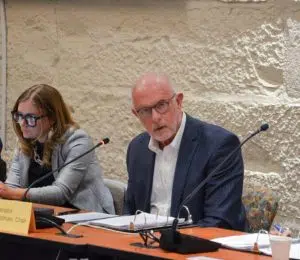
He spoke at the Interim State and Local Tax Review Task Force‘s second meeting, before former partners and proteges alike.
“Alaska was the last state to eliminate its income tax. That was back in 1980. I don’t know if it’s really applicable to Indiana,” Josh Goodman — senior officer of the Pew Charitable Trust’s state fiscal health project — told the task force.
“That was because they have all this revenue from oil,” he said, adding that non-income tax states generally have unique and large alternate revenue sources or have high sales taxes.
States’ pandemic-era surpluses are dissipating, according to Goodman.
Although Indiana is in a “better position than most states” financially, he cautioned that Hoosiers “aren’t immune to challenges.”
If lawmakers seek impactful, long-term policy changes, they’ll need to avoid both temporary budget shortfalls and extended structural deficits.
Goodman recommended that Indiana experiment with budget stress tests, in which officials identify hypothetical budget-crunching scenarios, analyze their potential impacts, and consider which financial tools could help close the theoretical gaps.
Long-term budget assessments, he said, could also guide deeper shifts. Rhode Island has used such an approach to figure out what it could afford in tax cuts, while New Mexico began saving millions to head off expected drops in oil production, for example.
Indiana is one of 30 states that has conducted neither, although it does regularly release two-year projections. Goodman suggested extending those further out in time.
And he lauded Indiana’s Legislative Services Agency for being a “leader” in tax incentive evaluation, and a “model for other states.”
See the full story here.